
Where it started
An industrial equipment distributor of about forty people, six of them reps who are constantly on the road: customer visits, trade shows, install follow-ups, on both sides of the border. Every trip is booked on the judgment of whoever is travelling, with no rule and no reference point.
The result is a travel budget that grows quarter after quarter, price gaps nobody can explain from one ticket to the next, and no way to tell whether a booking policy would make a real difference or an imaginary one.
The challenge
Answer three questions with data instead of impressions: what actually drives the price of a ticket, which of those factors the company controls, and whether any of it holds up as a policy in front of management.
What we built
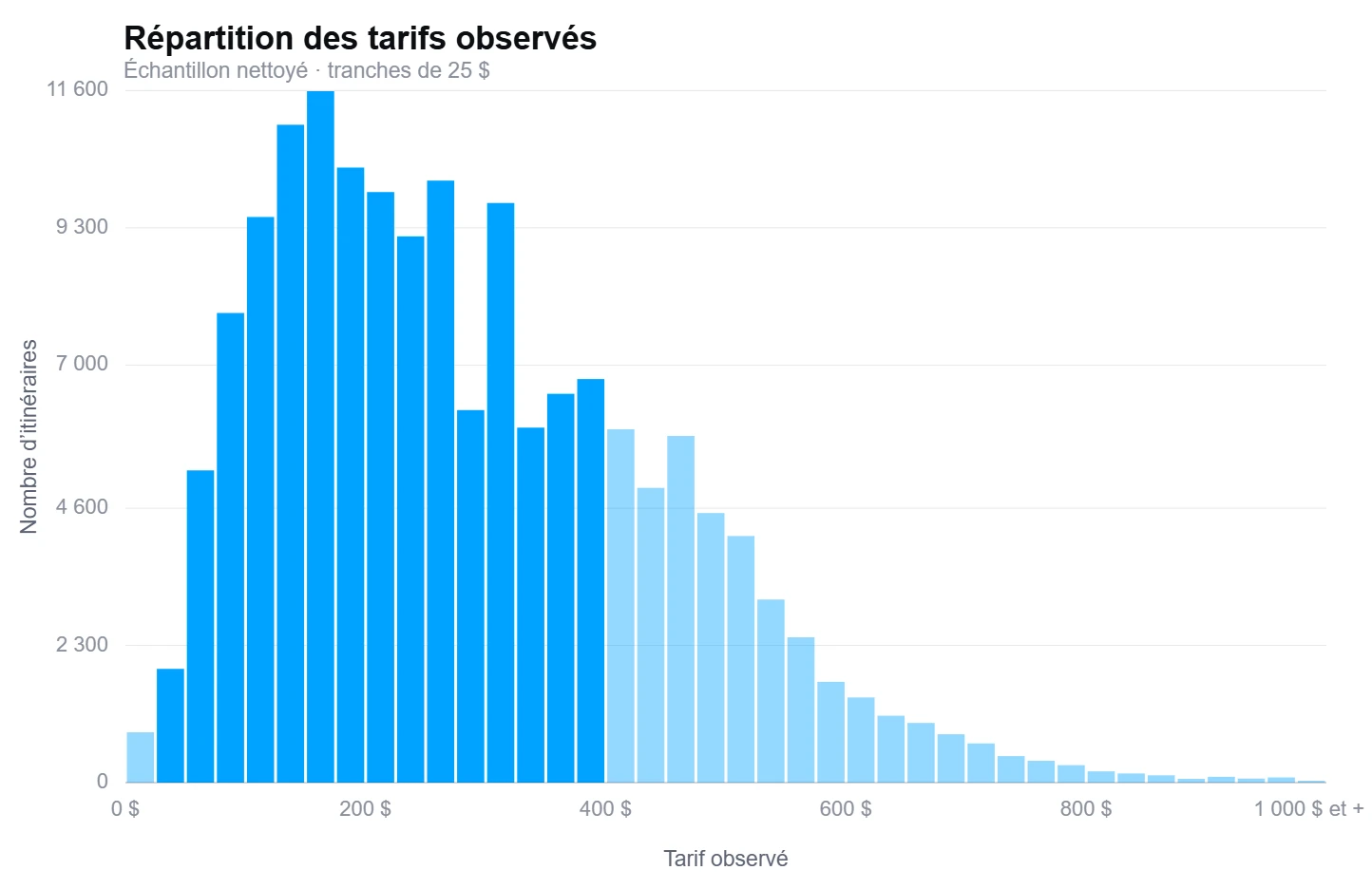
The starting point was raw: more than eight million itineraries. We sampled, cleaned and documented every decision along the way, from outliers removed to unusable variables dropped with a reason. The result is a dataset that is reliable and reproducible.
Every gap we observed then had to survive a statistical test before we kept it. Something visible to the eye is not automatically real. Two model families were put in competition on the same split, and the most explainable one was kept, not the most accurate. A negligible accuracy gap is not worth a policy nobody can justify.
No personal data was used. The analysis looks at the characteristics of itineraries, never at the people travelling. The mandate is presented here without naming the company, at its request.
How it unfolded
Framing
Three business questions written down before touching the data.
Cleaning
Outliers removed, unusable variables documented and then dropped.
Exploration and inference
Every observed gap confirmed by a statistical test before it was kept.
Modelling
Several approaches put in competition, judged on data they had never seen.
Decision
Four prioritized recommendations and an internal tool to apply them.

The results
The five cost drivers were ranked by impact and by how much control the company has over them. Only one came out significant, free and entirely in the company's hands. That is the one that became policy first.
Two assumed savings, taken for granted for years, do not hold up against the data. One of them was costing the reps time without saving anything. The company stopped applying them.
The mandate closed with four prioritized recommendations and an internal tool: the rep enters an itinerary and the tool shows the recommendation that applies, before the booking is made.
What the company gets out of it
A travel policy that holds
One simple rule, backed by tests rather than by a hunch at the end of a meeting, and clear enough to explain to the reps.
False savings taken off the table
Two inherited practices were costing time without saving anything. The company stopped enforcing them.
A tool instead of a report
The recommendation lives in something the rep opens before booking, not in a PDF that gets filed and forgotten.